
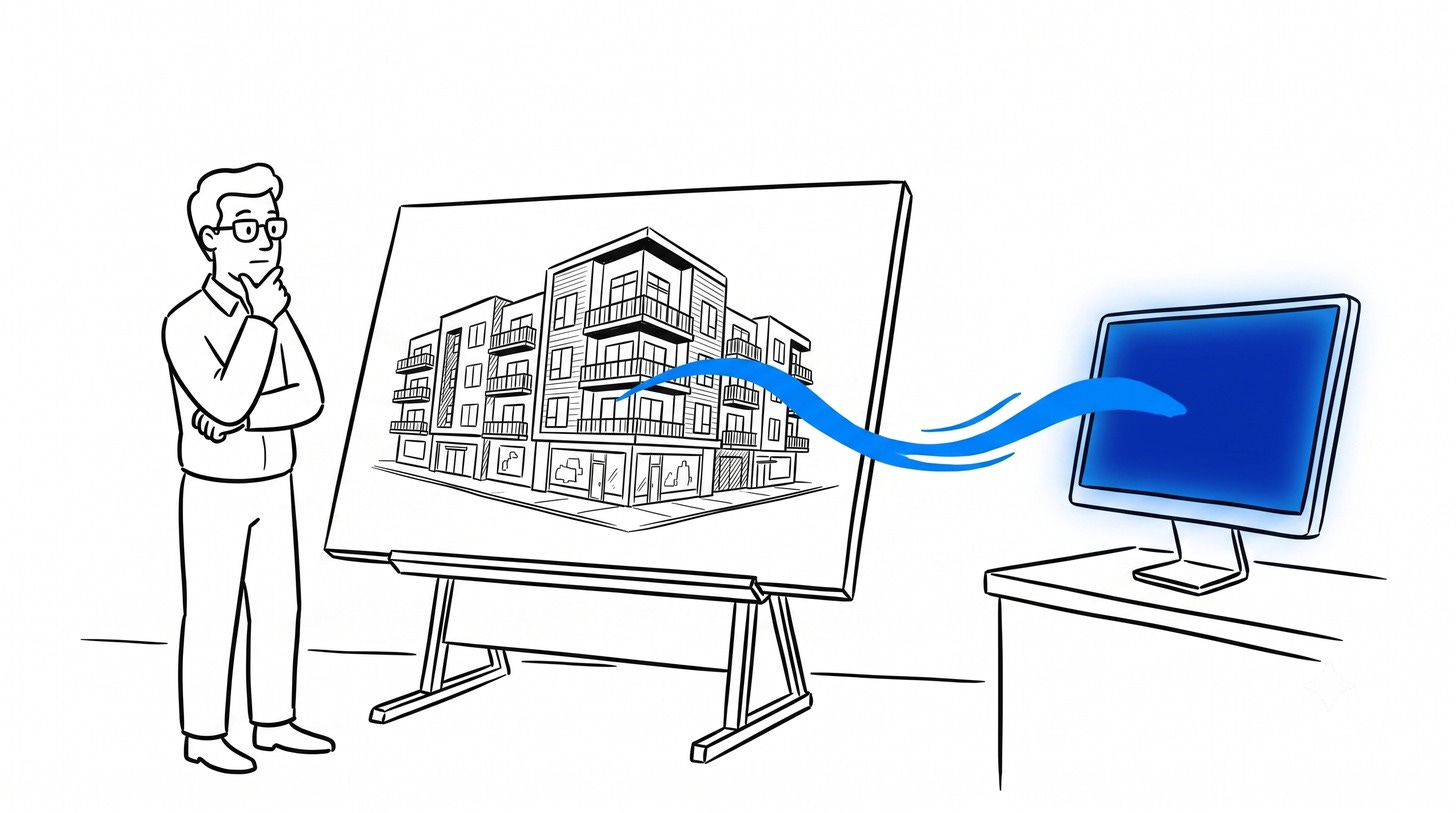
My first job out of college was writing software. As a graduate student, I studied information theory and MAP codes — based on theories presented by information theorist Claude Shannon, the eponym for the popular LLM model that I used to code our custom app. It’s no wonder that algorithms behind today’s AI models feel hauntingly familiar 30 years later.
The next decade was spent designing microchips — work in which a single logic error can cost the team a large amount of time and money to fix after fabrication. I enjoyed the rigor and discipline of thinking through problems before you start solving them. I loved the creativity of design work. But it was an unsatisfying profession for someone who likes getting away from the computer and lab bench and getting out into the community.
So, about twenty years ago I moved into real estate development. The technical instincts didn’t disappear, but they went dormant.
Real estate’s roots are not in software or electronics — they are in sticks, bricks, financing and services. So it’s no wonder that the industry software often feels like it was designed by a marriage of engineers and accountants, not a UX designer. Over the years, I would think: there has to be a more efficient way to do this. I would watch an analyst spend two days reconciling a deal package and think, “This should take an hour.” But the gap between seeing a solution and building one was wide enough that I always moved on. Hiring software developers is expensive. Building something real takes time. Running a real estate development firm is more than a full time job.
Recently, the gap between the practitioner, with domain experience, and the engineer, with technical experience, has closed markedly. So much so that I can confidently say the half of my career spent as a practitioner lends more to delivering an effective software solution than my prior years as an engineer (but an engineering mindset is crucial).
What changed
Claude Code is Anthropic’s development tool. It’s more than a code generator. It’s closer to having a software developer who can hold most (importantly, not all) of the context of a system in mind at once.
The quality of the output depends on your ability to describe what to build — employing the skills of a software product manager, like creating a product requirements document. The AI agent builds. You review. You refine. You hit a wall, you refine your approach, sometimes multiple times. Usually it solves it. Occasionally, you need to rearchitect the entire system from scratch and take another swing. We started on a Saturday with one problem in mind — underwriting throughput — and had a working prototype within a couple of weeks. Three coordinating systems were running in production inside a month. A handful of weekend sessions.
However, transitioning that minimum-viable-product into a robust, production-level system took months. Recoding, rearchitecting, refactoring code that had grown into a web. It wasn’t magic and I don’t think I’d describe it as “vibe coding.” One component failed because of a security restriction in the latest macOS — quietly changed, required real diagnosis, required redesigning the approach entirely. The iteration cycle felt familiar — like solving any real-world engineering problem. What changed was how fast each step moved.
Hardening the prototype into production forced a rigor we never needed to apply to a spreadsheet or CRM — securing a multi-tenant system and defending against prompt-injection, where a message tries to smuggle instructions to the AI.
What it revealed
I’ve spent twenty years at the intersection of capital, land, and community. The operational side of the business — tracking, modeling, updating — was always overhead.
Building these tools showed me that I’d underestimated the operational load of our business. Missed follow-ups by the team or long underwriting queues mean lost opportunities.
The tools didn’t change our strategy, but they did reveal how much of our execution was leaking.
Was this worth building?
Yes. Worst case, I became much more adept at using a modern software development tool. With that learning, I have since used Claude Code to develop other functional applications, such as a site-walk app that records photos, videos, and voice & written comments, then uses an LLM to help the user grade the physical condition of a building and populate a database so we have a scoreboard. We’ve prototyped an asset-management dashboard that keeps our forecasts current, organizes our files, and gives us quick access to information like specific commercial lease-terms at the click of a button.
I’m most excited for what this means for the software tools that will be available for our industry. At our company, we hand out socks that have the phrase “no s&*^ty buildings” printed on them to remind us to take pride in what we deliver. I’m excited for our industry to have access to tools that are a joy to use.
Internally, we were able to build software to address inefficiencies that are low-hanging fruit, improve the quality of our work, and, importantly, are easy and pleasant to use. Building beautiful software feels very similar to building beautiful buildings.
I got back something I hadn’t realized I’d missed. And in getting it back, I could see clearly — for the first time — what it had been costing us not to have it. P.S. A few people following this series have asked whether they can use what I built. I’ve started letting a small group of operators in. If you’d like to be one of them, reply — I’ll reach out as I open more spots.
Worth reading
Claude Code documentation, Anthropic. If you’ve read this series and are wondering whether to start: the documentation is more accessible than the technical framing suggests. The question worth sitting with isn’t whether you can build this. It’s whether you’re clear enough about the problem you’re trying to solve.
The File System is the new Database — the first thing I read when I set out to harness Claude; it laid out the progressive-disclosure approach I used to get immediate results, starting with a personal productivity system that grew into the software behind this work.
Compound Engineering by Every.to — the agent-first development method I started from and later adapted to my own workflow; the place to go if you want a concrete system for building with AI rather than just prompting it.